
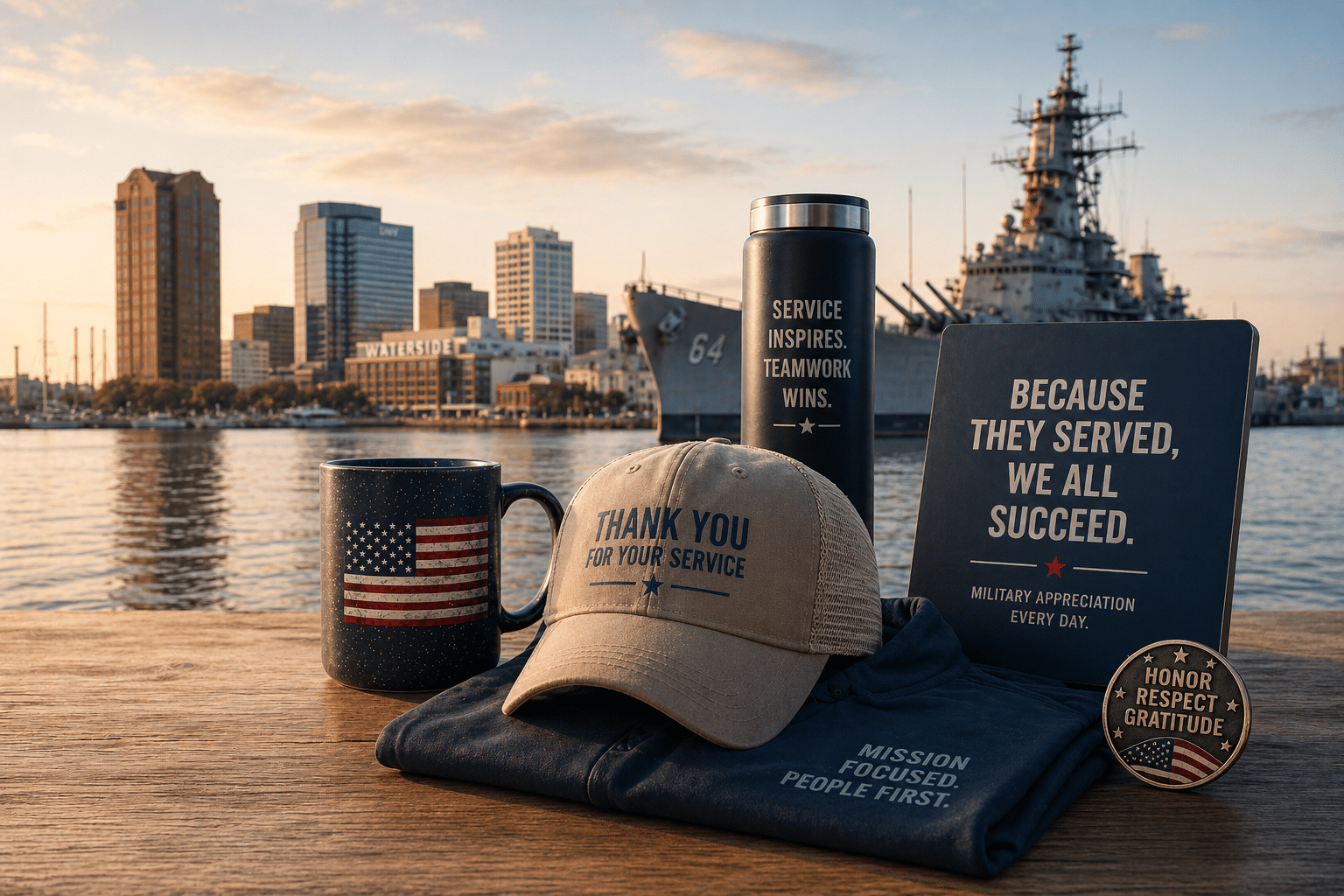
The Flag on the Mug Isn’t Enough: A Hampton Roads Employer’s Guide to Military Appreciation That Actually Lands
Read Time:
11.2 minutes
Categories:
Date Posted:
February 2, 2026
May is full of well-meaning gestures that veterans quietly roll their eyes at. Here’s how to not be one of them.
Every May, employers across Hampton Roads go through the same ritual. Someone in HR orders a batch of red-white-and-blue koozies. The CEO sends a company-wide email with “Thank you for your service” in the subject line. Maybe there’s a cake in the break room with a small American flag stuck in it. And then May 26 passes, everyone goes back to work, and the veterans on staff feel roughly the same as they did before the cake.
This is not a Hampton Roads problem specifically. It happens everywhere. But it lands differently here, in a region where the military is not a distant institution but the defining feature of the local economy and workforce. Nearly 220,000 veterans live in Hampton Roads. The military accounts for roughly 40 percent of the region’s gross regional product. Virginia ranks first in the country for veterans in the workforce. If you are a defense contractor, a shipbuilding firm, a federal services company, or any employer of scale in Virginia Beach or Norfolk, a meaningful portion of your workforce has worn a uniform. They know the difference between appreciation and the appearance of appreciation. And they are not impressed by a koozie.
The question isn’t whether to mark Armed Forces Day and Memorial Day. You should. The question is whether the thing you do earns the moment or just checks a box.
Key takeaways
- Hampton Roads has one of the densest veteran workforces in the country. Generic appreciation gestures register as hollow, and veterans know the difference.
- The most common mistake isn’t bad intentions , it’s ordering for the calendar rather than the people. Timing an order around a holiday doesn’t make it meaningful.
- There are real trademark and IP restrictions around military branch insignia that trip up employers every year. Know them before you print anything.
- The merch that lands is the kind that travels beyond May , items people use in their daily lives that quietly carry the recognition forward.
- Employers who connect appreciation to year-round programs, not a single annual gesture, get the retention and culture outcomes they’re actually after.
Table of contents
- The official story: showing up in May is enough
- The reality: veterans can tell the difference between a program and a gesture
- The trademark problem nobody talks about until it’s too late
- What actually works: the four qualities of military appreciation merch that means something
- Your Armed Forces Day and Memorial Day playbook
- The question that separates a gesture from a program
The official story: showing up in May is enough
The logic behind the annual May ritual makes sense on paper. National Military Appreciation Month, Armed Forces Day on May 17, Memorial Day on May 26, there are enough calendar anchors to give any HR or marketing team a clear lane. Order something patriotic. Send something to the team. Post something on LinkedIn. You showed up. You honored the moment. Done.
There’s a version of this that works fine for general brand awareness purposes, the kind of military appreciation marketing that consumer brands do for customers. A retail discount, a social media acknowledgment, a donation tied to the month. That’s legitimate and it’s appreciated.
But that’s not the audience this post is for. This is for the employers in Virginia Beach, Norfolk, Chesapeake, and the surrounding region whose workforce includes veterans who work alongside them every day. For those employers, the question isn’t whether your brand showed up for Military Appreciation Month. It’s whether the people you’re trying to honor felt it.
The reality: veterans can tell the difference between a program and a gesture
Here is what the research on veteran workplace recognition consistently shows, and what any candid conversation with a veteran employee will confirm: most veterans do not want to be singled out for public performance. Many actively prefer not to be. What they do respond to is being seen, not celebrated for a day, but recognized as part of a culture that actually understands what military service means.
The koozie fails not because it’s a bad product. It fails because it signals that nobody thought past the calendar. The item was ordered because a date was coming, not because someone considered what would actually resonate with the person receiving it. Veterans with twenty years of service recognizing cheap merch as swag. They’ve been given enough of it to know.
The employers who get this right in Hampton Roads tend to share a few traits. They ask before they assume. Some veterans welcome public recognition, others don’t, and HR should know the difference for their team before planning anything. They think about what the item does after the moment , whether it ends up in a drawer or gets used every day. And they connect the May gesture to something larger: a veterans employee resource group, a year-round recognition program, a hiring commitment to transitioning service members, a partnership with a local veterans nonprofit. The appreciation moment lands differently when it’s one touchpoint in a program rather than the whole program itself.
Hampton Roads is not a place where you can fake military appreciation and have it go unnoticed. About 40% of veterans who separate from the military stay in the Hampton Roads region. They’re your employees, your managers, your operations leads, and in many cases your clients. They talk to each other. They know which employers invest in military culture and which ones order flag merch in late April because someone put it on the Q2 to-do list.
The trademark problem nobody talks about until it’s too late
This section belongs in every guide about military appreciation merch and almost never appears in one.
If you are planning to put military branch insignia on merchandise, including the Eagle, Globe, and Anchor; the Army Star; the Air Force Symbol; branch seals; service flags , on branded merchandise, you need to understand the licensing rules first. Each branch of the military manages its own trademark licensing program. Using official insignia on merchandise without proper authorization isn’t just a design preference issue. It’s a legal one, and it’s the kind of thing that turns a thoughtful recognition program into an embarrassing compliance problem.
The Army Trademark Licensing Program, for instance, is explicit: Army marks belong exclusively to the Army and are not to be used by third parties without a license. Similar rules govern the Navy, Marine Corps, Air Force, Coast Guard, and Space Force. The rules apply whether you’re selling the items or giving them away.
This doesn’t mean you can’t create military-themed recognition items. It means you need to work with a promotional products partner who understands the boundaries, who knows the difference between compliant patriotic design and unauthorized use of branch insignia, and who can guide your creative direction accordingly. There are excellent options: custom challenge coins with your company mark alongside a service branch reference that doesn’t infringe, custom apparel in branch-associated colors with design elements that honor without reproducing protected marks, American-made products that carry their own statement about values.
A good merch partner will raise this with you before the file goes to print. If yours doesn’t, ask the question yourself.
What actually works: the four qualities of military appreciation merch that means something
There’s no single product that works for every veteran workforce. But there are four qualities that consistently separate the recognition items that land from the ones that end up in a box.
-
It has staying power.
The test for any recognition item is simple: where will it be in six months? A quality tumbler, a well-made jacket, a durable bag, a custom challenge coin, these are items people keep and use. A paper bag of candy corn with a flag on it is not. Staying power correlates almost directly with perceived quality. Veterans who spent years working with equipment where quality is a life-or-death variable notice when something is made well. The inverse is equally true.
-
It fits the actual work environment.
A defense contractor workforce in Virginia Beach has specific environments: field crews, office teams, engineering divisions, project managers who split time between a desk and a jobsite. The merch should map to how people actually work. Technical outerwear for field teams. Quality branded drinkware for everyone. A custom recognition item tied to service tenure or a specific program milestone. What doesn’t work is one-size-fits-all items ordered in bulk for a mixed workforce without thinking about who does what.
-
It connects to the company, not just the holiday.
The items that resonate most are the ones that say something specific about the relationship between the employer and the veteran, not just a general statement about America. A custom piece with the company mark alongside a service recognition element. A program-specific item tied to a veteran hiring initiative or ERG. Something that says “we see your service in the context of your work here” rather than “it’s May and this is what we ordered.”
-
It’s part of something, not the whole thing.
A single item can open a door, but it can’t carry a recognition program by itself. The employers in Hampton Roads who build genuine military culture use merch as one touchpoint in a broader system: year-round recognition, leadership that understands military transition, veteran-to-veteran mentorship, and visible commitment to hiring transitioning service members. The May item matters more when it’s part of a story the company has been telling all year.
Your Armed Forces Day and Memorial Day playbook
Armed Forces Day falls on Saturday, May 17, 2026. Memorial Day is Monday, May 25. That gives Hampton Roads employers a natural two-week window for meaningful recognition. Here’s how to use it well.
Start with a conversation, not a catalog.
Before ordering anything, have HR survey or informally check in with veteran employees about what kind of recognition they’d actually welcome. Not every veteran wants to be publicly acknowledged. Some prefer private recognition. Some want nothing beyond a thoughtful one-on-one acknowledgment from their manager. Knowing this before you plan the May program changes what you do and makes it better.
Distinguish Armed Forces Day from Memorial Day.
These are different observances with different emotional weights. Armed Forces Day honors those currently serving. Memorial Day is for those who died in service. The tone and type of recognition should reflect that distinction. A celebratory team event fits Armed Forces Day. Memorial Day calls for something quieter, a moment of reflection, a donation to a veterans-focused organization, a written acknowledgment from leadership. Conflating them into one big May appreciation push misses the difference and signals that the planning wasn’t very deep.
For branded recognition items, choose quality over quantity.
One well-made item beats four forgettable ones. Think about a branded insulated tumbler, a quality embroidered jacket or vest, a custom challenge coin with your company mark and a service recognition element. If budget is a constraint, a single excellent item for your veteran employees specifically goes further than a lower-quality item distributed company-wide.
Build in something that lasts past May.
Connect the recognition to something ongoing: announce a veterans ERG launch, share your commitment to hiring from the transitioning service member pipeline (HIRE Vets NOW events run regularly at Naval Station Norfolk), introduce a peer recognition program tied to military service values your company has formally adopted. The May moment becomes an anchor for something larger rather than a standalone event.
Work with a partner who knows the market.
In Hampton Roads, the best promotional products partner for military appreciation programs is one who has worked with defense contractors and military-affiliated organizations before, who understands the IP rules, knows what quality looks like to a veteran audience, and has production capability local enough to turn orders quickly when your planning calendar runs tight. The two-week gap between Armed Forces Day and Memorial Day is short. Local production matters.
The question that separates a gesture from a program
There’s a useful test for any military appreciation initiative, and it goes like this: if you removed the calendar entirely, if there were no Armed Forces Day, no Memorial Day, no Military Appreciation Month , would your organization still do something to recognize the veterans on your team?
If the honest answer is no, then what you’re building is a calendar response, not a culture. That’s not worthless. It’s better than nothing. But it’s not what the best employers in Hampton Roads are doing, and it’s not what the veterans on your team are hoping for.
The companies that have earned genuine loyalty from their veteran workforce didn’t earn it in May. They earned it in January and August and October, in how they onboard transitioning service members, how they promote from within, how they talk about service as a value rather than a marketing moment. May is when they have a chance to reinforce that story with something tangible.
What you put in the box matters. But what the box represents matters more.
MSP Design Group has worked with defense contractors, federal services firms, and military-affiliated employers across Hampton Roads for decades. We understand the IP rules, the quality standards that resonate with a veteran workforce, and what it takes to deliver programs that mean something beyond the calendar. If you’re building a military appreciation program for your team , or rebuilding one that hasn’t been working , we’d welcome the conversation. Talk to our team.


Increase Your Results with Branded Merchandise Solutions

Elevate Your Brand with Custom Merchandise
Our personalized service, global sourcing, local production, and in-house creative team make finding the perfect promotional products a breeze.
Discover the Perfect Promotional Products for Your Brand! Click Here to Get Started.

Design Custom Apparel that People Love to Wear
Our 100,000 sq ft state-of-the-art facility handles a wide range of apparel and decoration methods. Let’s create something on-trend and truly unique for your brand.
Create Trendy, Custom Apparel for Your Brand!

Make A Lasting Impression with Impactful Visual Communications
From signage and wayfinding to environmental graphics, our expert team can create custom solutions that elevate your brand and guide your audience.
Elevate Your Brand with Custom Visual Communications! Click Here to Learn More.
 Online Solutions to Elevate Your Brand
 Online Solutions to Elevate Your Brand
Our ecommerce solutions are perfect for gifting, rewards and recognition programs, team gear, fundraising, or selling your products directly to customers. Our advanced platforms offer seamless shopping experiences, fun gifting options, and secure transactions.
Boost Your Brand with Our Ecommerce Solutions! Click Here to Explore.
We Do the Heavy Lifting So You Don’t Have To
 We Do the Heavy Lifting So You Don’t Have To
MSP Design Group provides an in-house, NetSuite enabled kitting, warehouse and fulfillment facility. We provide end-to-end solutions tailored to your unique needs. With complete control of our processes, your program is in excellent hands.
Streamline Your Operations with Our End-to-End Solutions!
Our In-House Creative Team Has You Covered
 Our In-House Creative Team Has You Covered
Looking to create your own unique apparel designs? Envision a unique product that doesn’t exist yet? Want to create a new experience? MSP Design Group’s team of in-house creatives, designers, merchandisers and program experts are ready to help bring your vision to life.
Bring Your Vision to Life with Our In-House Creative Team! Click Here to Learn More.


