Your New Hire’s First Impression of Your Company Is Already Formed. Did You Influence It?
Read Time:
12.8 minutes
Categories:
Date Posted:
February 5, 2026
RTP companies spend months recruiting top talent, then hand them a tote bag with a coffee mug and call it a welcome.
There is a moment , it happens in the week before someone’s first day, or on the morning of it , where a new hire forms an impression that will shape how they feel about joining your company for the next six months. Not what the recruiter said. Not the job description. Not even the offer letter. The physical experience of being welcomed.
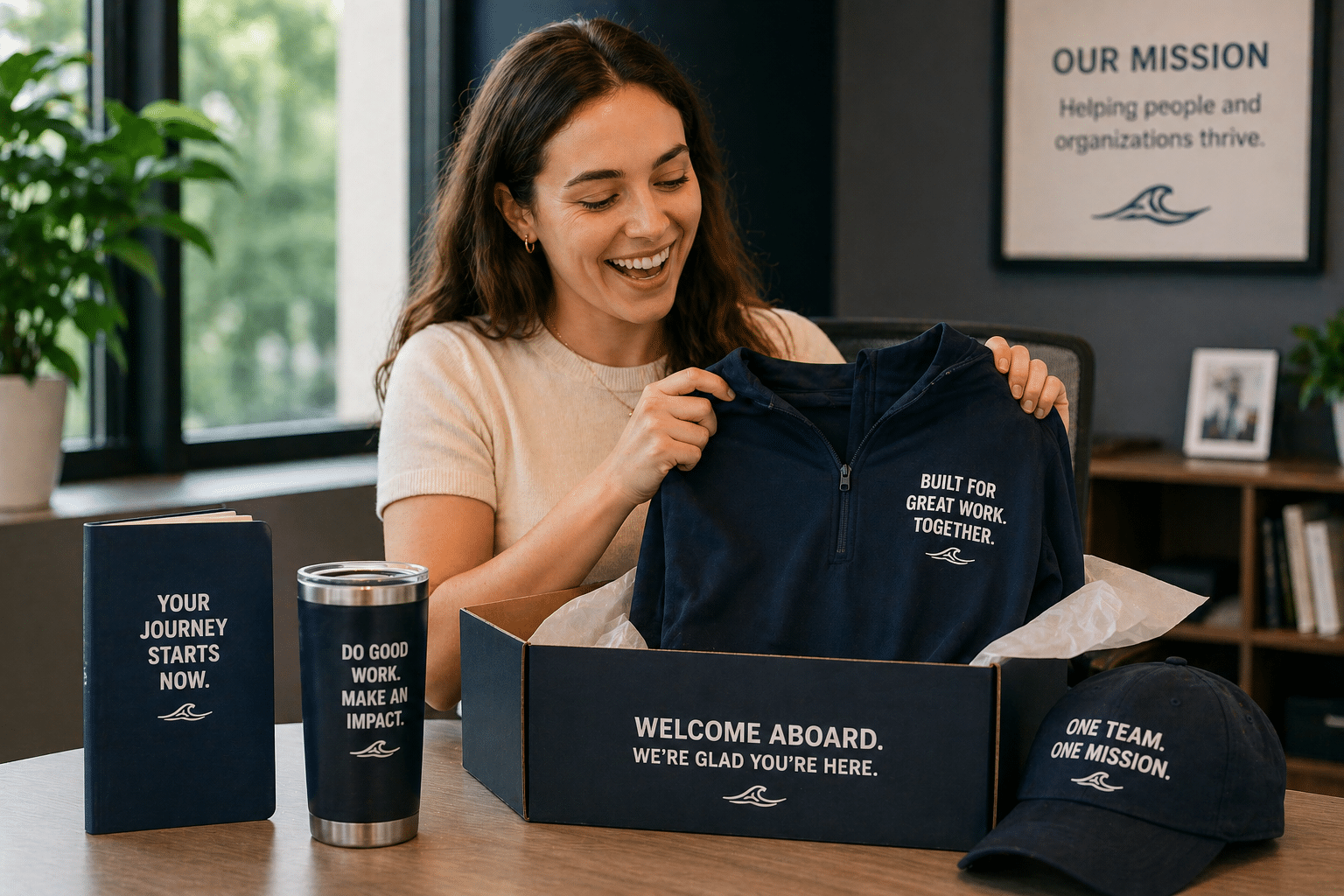
For a growing number of people joining companies in the Research Triangle, that experience involves a box. Maybe it arrives on the doorstep before day one. Maybe it’s waiting on the desk. Either way, it carries a message about what kind of company this is, one that thought about you specifically, or one that ordered in bulk and hoped for the best.
The triangle region runs one of the most competitive tech labor markets in the country. SAS has a 90% employee retention rate and has spent decades building an intentional culture as a competitive advantage. Apple’s RTP campus is scaling toward 3,000 roles. IBM, Cisco, Red Hat, and dozens of fast-growing life sciences and software companies are all fishing from the same talent pool. When the job market is this dense, the experience you create in the first 72 hours of someone’s employment isn’t a nice-to-have. It’s a retention strategy.
And most onboarding kits are not doing that job.
Key takeaways
- The onboarding kit is the first physical proof that the offer you made is real. A generic kit signals generic culture , and RTP talent, who chose between multiple offers, notices.
- The most common failure isn’t bad products. It’s products selected for what they look like in a catalog rather than how they land for a specific person in a specific role.
- Hybrid and remote employees need kits even more than in-office hires. Without the physical environment of an office, the box is the culture.
- Kit timing matters as much as kit contents. A welcome box that arrives on day three isn’t doing what a box that arrives three days before day one does.
- There are five questions every people ops team should ask before designing or refreshing their onboarding kit , and most teams skip at least three of them.
Table of contents
- The official story: any branded kit is better than nothing
- The reality: a generic kit can make the first impression worse
- Why RTP companies have less margin for error than they think
- The five questions that determine whether your kit actually works
- What a well-designed onboarding kit contains , and what it doesn’t
- Your onboarding kit playbook for the Triangle market
- The question worth asking before you reorder
The official story: any branded kit is better than nothing
The conventional wisdom in people ops is that onboarding kits are inherently good. Put something on the desk or ship something to the door. Branded merch creates culture. A welcome box says we’re glad you’re here. And yes, some of that is true. A kit is better than nothing. The bar is low enough that clearing it at all earns some goodwill.
But the “any kit is better than none” logic has a ceiling, and a lot of companies in the Triangle are bumping up against it. The problem isn’t the category. It’s the execution. And the execution problem almost always traces back to the same root: the kit was designed around what was easy to order, not what would actually land with the person receiving it.
A t-shirt in the wrong size. A mug that’s nice enough but has nothing to do with why this person was excited to join. A tote bag that’s the fourth tote bag they’ve received from an employer in five years. A cheap pen. A phone stand that doesn’t work with their phone. These aren’t hypotheticals, they’re the standard contents of a significant percentage of new hire kits shipping into Triangle companies right now.
The new hire who unboxes that kit doesn’t say “this is better than nothing.” They say “hm”, and they file away a data point.
The reality: a generic kit can make the first impression worse
Here’s the thing about first impressions: they don’t fail neutrally. A weak onboarding kit doesn’t just fail to build connection, it can actively undermine the impression the recruiting process built. Your recruiter sold this person on culture, mission, and intentionality. Your kit sold them on bulk ordering.
Research from Brandon Hall Group found that a structured onboarding process improves new hire retention by 82% and productivity by over 70%. The operative word is structured, which means intentional, which means designed around an outcome rather than assembled from whatever your promotional products vendor had in stock.
Enboarder’s data shows that 86% of new hires decide how long they’ll stay with a company within the first six months. The onboarding kit isn’t the only variable in that decision, but it’s the most controllable first-impression variable you have. It’s the one signal you design entirely in advance, on your own timeline, with complete creative control.
When that signal says “we didn’t really think about you specifically,” it does damage that takes months to repair. And in a market where your new hire turned down another offer to join you, that damage has a cost.
Why RTP companies have less margin for error than they think
A tech hire in Research Triangle Park is not coming from a market with limited options. They come from a market where IBM, Cisco, SAS, Red Hat, Pendo, Bandwidth, Wolfspeed, and Apple are all actively hiring, all within a 20-mile radius, many within the same 7,000-acre campus. Raleigh’s tech sector accounts for over 18% of local employment and is expected to grow 20% by 2026. The average tech salary in the market runs over $100,000. These are candidates with choices.
What that means for people ops and talent teams is that the post-offer, pre-start window (the period between when someone signs and when they walk in the door) , is more fragile than it used to be. Poor onboarding can cost companies up to $240,000 per bad hire. And “bad hire” doesn’t only mean someone who fails at the job. It includes the person who was perfectly capable and chose to leave within a year because the experience of joining never matched the experience of being recruited.
The onboarding kit lands squarely in that window. A box that arrives five days before start date, curated thoughtfully, with items that reflect the role and the culture, does something a box arriving on day three cannot do: it closes the gap between “I accepted the offer” and “I made the right decision.”
For remote and hybrid employees , a significant portion of many RTP companies’ headcount , that gap is even wider and the kit matters even more. Only 25% of remote and hybrid employees feel a strong connection to their organization’s culture. Without a physical office to reinforce belonging, the kit is the culture. It’s the most tangible proof that the company they’re joining is real and that someone thought about their arrival.
The five questions that determine whether your kit actually works
Most people ops teams skip at least three of these. That’s why most kits underperform.
-
Who specifically is receiving this kit?
Not “our new hires”, the actual person. Their role. Whether they’re remote or in-office. Whether they’re a senior hire coming from a competitor or an early-career engineer right out of NC State. Whether they work at a desk all day or spend half their time in meetings and travel. The right kit for a senior enterprise sales hire in Durham is not the right kit for a software engineer joining a hybrid team in Cary. If your kit is identical across roles and levels, it’s generic by design.
-
What one feeling should they have when they open it?
This is the question most kit design conversations skip entirely. They jump straight to product selection without establishing the emotional target. “Welcome” isn’t an answer, it’s too broad. “You made the right call” is an answer. “You’re going to fit in here” is an answer. “We are exactly as good as we said we were” is an answer. The products flow from the feeling, not the other way around.
-
Would the items in this kit end up on the desk or in a drawer?
Everything in an onboarding kit should pass a simple desk test: is this something a person would actually use in their working life? A quality insulated tumbler they’ll use every morning? Desk. A stress ball with your logo on it? Drawer. A notebook with a cover that doesn’t look embarrassing in a client meeting? Desk. A branded pen that skips and runs dry in two weeks? Trash. Usage is what generates the downstream brand impression. Items that live in a drawer generate nothing.
-
When does it arrive, and does that timing reinforce the experience you’re trying to create?
A kit that arrives the Tuesday after someone starts is a recovery gesture, not a welcome. The timing window that works is three to seven days before day one, early enough to build excitement, close enough that it doesn’t feel routine by start date. This requires having a fulfillment process that can actually hit that window, which is a harder operational problem than most teams realize until their third late shipment.
-
How does it connect to what comes next?
The best onboarding kits are the opening move in a longer sequence. There’s a note from the manager. The kit references the team Slack channel. There’s a small card about what to expect on day one. The items connect to rituals or programs the company actually runs. A kit that arrives in a vacuum, with no thread to what comes next, feels transactional. A kit that’s clearly the beginning of something feels like belonging.
What a well-designed onboarding kit contains , and what it doesn’t
There’s no single product list that works for every company. But there are consistent patterns in the kits that get results versus the ones that get forgotten.
What consistently works:
Quality drinkware, particularly insulated tumblers that people use every day. Not a $6 mug. The kind they’ll carry to meetings for two years. A well-made jacket, quarter-zip, or lightweight layer that fits how people actually dress in a tech environment in the Triangle. Something specific to the role or team , a technical book, a relevant resource, something that signals “we knew what you were hired to do.” A handwritten or printed note from the manager. Packaging that reflects the same standard as the products inside it.
What consistently doesn’t work:
Products selected based on unit cost rather than perceived value. Items that prioritize logo placement over usefulness. Anything that looks like it came from a generic promotional products catalog without thought for the recipient. Cheap pens, foam stress toys, branded candy. Five items of medium quality when two items of high quality would land harder. Excessive plastic packaging from a company that tells recruits they care about sustainability.
The budget range that hits the right balance for most RTP companies falls in the $75 to $150 per hire zone. The difference between a $60 kit and a $120 kit in perceived quality is significant. The difference between a $120 kit and a $200 kit is often not. Invest in fewer, better items.
Your onboarding kit playbook for the Triangle market
Building a kit program that actually works in the Raleigh-Durham market comes down to five operational decisions most companies get wrong.
Define the kit tiers before the products. Most companies need at least two tiers: a standard new hire kit and an elevated kit for senior or strategic hires. Maybe a third tier for remote-only employees if that population has meaningfully different needs. Decide the tiers first, then design products for each tier. The alternative , one kit for everyone , either overspends on entry-level hires or undersells senior ones.
Solve the timing problem before it becomes a problem. The number one fulfillment failure in onboarding kit programs is kits that arrive late. This is almost always because the internal request process (HR notifies the vendor, vendor ships, package arrives) has more days built into it than anyone realized. The fix is either building buffer time into the process , triggering kit orders the moment an offer is signed rather than when it’s accepted , or working with a partner who has local production and faster turn times. Virginia Beach to Raleigh-Durham is a six-hour drive. Same-region fulfillment means late-arriving kits don’t have to be the default.
Build in a sizing problem solution. Apparel sizing is the single most common source of waste in onboarding kit programs. Order in advance of knowing sizing and you’ll have boxes of smalls that nobody claimed. Order after hire and you lose the pre-day-one timing window. The clean solution is either a pre-boarding sizing capture (a short form that goes out with the welcome email) or using an on-demand fulfillment model that prints and ships per-order rather than maintaining standing inventory.
Tie the kit to a program, not just a date. The kit should connect forward. What’s the next touchpoint after the box? Who sends it? What does day one look like relative to what the kit promised? The people ops teams getting the most value from their kits treat them as chapter one of the onboarding narrative, with the manager, the buddy, and the team all part of the same story.
Review it every six months, not every two years. Kits go stale. Products go out of style. Quality on a specific item starts slipping when a vendor changes suppliers. Companies that treat the kit as a one-time design project find themselves two years later handing people an item that has nothing to do with who the company has become. Set a calendar reminder. Review usage, gather feedback from recent hires, refresh at least one item per cycle.
The question worth asking before you reorder
Most companies reorder their onboarding kit when they run out of inventory. That is the wrong trigger.
The right question is: does this kit still represent the company we are, for the employees we’re trying to hire, in the market we’re competing in? If the last kit refresh was eighteen months ago and your company has doubled its headcount, launched a new product line, or shifted from in-office to hybrid, the answer to that question is probably no.
The RTP talent market is not forgiving of employers who get complacent about the new hire experience. The companies here that retain people , the ones with retention rates that make their competitors nervous , are the ones that treat onboarding as a rolling program rather than a solved problem. The kit is part of that. Not the whole thing, but a visible, tangible, controllable part of it.
The new hire opening your box next week already made a decision about you. The question is whether you made a decision about them first.
MSP Design Group designs and fulfills onboarding kit programs for companies across Virginia and the Carolinas. Our 100,000 sq ft Virginia Beach facility handles production, kitting, and fulfillment in-house , which means faster turn times, tighter quality control, and a fulfillment partner who can actually hit your pre-day-one timing window. If your current kit program isn’t working the way it should, we’d welcome a conversation about what’s getting in the way. Talk to our Team


Increase Your Results with Branded Merchandise Solutions
Elevate Your Brand with Custom Merchandise
Our personalized service, global sourcing, local production, and in-house creative team make finding the perfect promotional products a breeze.
Discover the Perfect Promotional Products for Your Brand! Click Here to Get Started.
Design Custom Apparel that People Love to Wear
Our 100,000 sq ft state-of-the-art facility handles a wide range of apparel and decoration methods. Let’s create something on-trend and truly unique for your brand.
Create Trendy, Custom Apparel for Your Brand!
Make A Lasting Impression with Impactful Visual Communications
From signage and wayfinding to environmental graphics, our expert team can create custom solutions that elevate your brand and guide your audience.
Elevate Your Brand with Custom Visual Communications! Click Here to Learn More.
 Online Solutions to Elevate Your Brand
 Online Solutions to Elevate Your Brand
Our ecommerce solutions are perfect for gifting, rewards and recognition programs, team gear, fundraising, or selling your products directly to customers. Our advanced platforms offer seamless shopping experiences, fun gifting options, and secure transactions.
Boost Your Brand with Our Ecommerce Solutions! Click Here to Explore.
We Do the Heavy Lifting So You Don’t Have To
 We Do the Heavy Lifting So You Don’t Have To
MSP Design Group provides an in-house, NetSuite enabled kitting, warehouse and fulfillment facility. We provide end-to-end solutions tailored to your unique needs. With complete control of our processes, your program is in excellent hands.
Streamline Your Operations with Our End-to-End Solutions!
Our In-House Creative Team Has You Covered
 Our In-House Creative Team Has You Covered
Looking to create your own unique apparel designs? Envision a unique product that doesn’t exist yet? Want to create a new experience? MSP Design Group’s team of in-house creatives, designers, merchandisers and program experts are ready to help bring your vision to life.
Bring Your Vision to Life with Our In-House Creative Team! Click Here to Learn More.

