This Summer in Hampton Roads Is Unlike Any Other. Is Your Brand Ready for It?
Read Time:
13.9 minutes
Categories:
Tags:
Date Posted:
February 3, 2026
June 19–22, 2026: Sail250, the 50th annual Norfolk Harborfest, and Juneteenth converge on the same waterfront weekend. Most sponsors will show up underprepared. Here’s how not to be one of them.
There are summers, and then there are summers. Hampton Roads has always had an exceptional event season, the kind of calendar that draws hundreds of thousands of visitors to the oceanfront and the waterfront between May and September. But 2026 is not a normal year.
In a four-day window starting June 19, Norfolk’s downtown waterfront will host three separate major events simultaneously: Sail250® Virginia, the largest tall ship gathering in Hampton Roads history with 63 ships from approximately 20 countries; the 50th Annual Norfolk Harborfest, one of the region’s most beloved waterfront festivals at its golden anniversary; and the national Juneteenth holiday celebration. More than 14,000 international officers, cadets, and crew members will be participating. The Blue Angels will fly over the 26-nautical-mile Parade of Sail. All events are free and open to the public.
That is not a normal June weekend. That is a once-in-a-generation convergence that regional brands and sponsors have been circling on their calendars for three years.
And a significant number of them will show up with a folding table, a banner that flaps in the ocean breeze, and a tote bag nobody wanted.
This post is for the ones who want to do it better.
Key takeaways
- Summer 2026 in Hampton Roads runs from the Sail250/Harborfest/Juneteenth convergence in June through Neptune Festival in September, with multiple high-attendance events in between. Each has a different audience, a different energy, and different merchandise needs.
- The single most common outdoor event sponsor mistake is not bad products , it’s the wrong products for the environment. Beach and waterfront events are brutal on cheap signage and giveaways that weren’t designed for heat, wind, and sun.
- Signage and giveaways are two different problems. Most sponsors blur them together and underinvest in both. A clear strategy for each produces dramatically better results.
- Lead time is the hidden variable that kills otherwise good event programs. Production, shipping, and setup all require time that brands consistently underestimate.
- Local production in Virginia Beach is not just a supply chain preference , it’s an operational advantage when you need to reorder a banner on a Thursday for a Saturday event.
Table of contents
- The official story: show up, set up a banner, hand out some stuff
- The reality: an outdoor event environment is not forgiving of generic
- The 2026 Hampton Roads summer calendar you need to know
- What actually works for waterfront and beach event sponsorship
- The signage problem: what outdoor means in Virginia
- The giveaway problem: what stays and what gets left on the boardwalk
- Your Hampton Roads summer sponsor playbook
- The question worth asking before you book the booth
The official story: show up, set up a banner, hand out some stuff
The conventional approach to event sponsorship looks like this: sign the contract, order some branded items, show up on the day with a table and a banner, hand out pens or koozies until the box is empty, and leave. Budget spent, box checked, sponsorship fulfilled.
For a lot of regional brands, this is how event season has always worked. The sponsorship gets the logo on the event materials. The booth gets the logo in front of people. The items get the logo into people’s hands. Done.
The problem with this approach is not that it’s wrong. It’s that it’s baseline, and baseline looks particularly bad when your booth is next to one that actually thought about the experience they were creating. And it looks especially bad in 2026, when the events your brand is appearing at are some of the most attended and most photographed in Hampton Roads history.
A banner that’s faded and flapping in the June wind at Harborfest is being photographed from a hundred angles by people who weren’t even focused on your booth. A giveaway item that nobody picks up off the table is a data point. The good news is that the gap between baseline and good is not a budget problem. It’s a planning problem. And planning problems are solvable.
The reality: an outdoor event environment is not forgiving of generic
Outdoor events along the Virginia coast are visually beautiful and physically punishing on anything not designed for the conditions. Sun, heat, wind, salt air, humidity, these are not theoretical variables. They are the conditions your signage and branded items will face from the moment setup begins until the moment you break down.
Heat causes ink adhesion to fail on cheap vinyl banners. UV exposure fades colors on signage that wasn’t printed with outdoor-rated inks. Wind collapses tents that weren’t properly ballasted, takes down A-frame displays that weren’t weighted, and turns feather flags into liabilities if the hardware isn’t rated for it. Giveaway items that live in a box in the sun for four hours , foam stress balls, cheap pens, candy , become things nobody wants by the time the crowds arrive. Fabric items that weren’t pre-shrunk look different at the end of the day than they did at the start.
None of this is secret knowledge. It is the lived experience of every brand that has sponsored a Hampton Roads waterfront event. The mistake is treating it as unpredictable rather than plannable. The environment at Harborfest in June is exactly as described above, every year, reliably. Building your signage and merchandise program around that reality is the job.
The 2026 Hampton Roads summer calendar you need to know
This is not a normal event season. Plan accordingly.
May: Opening act
The season opens with Memorial Day Weekend Salute to Summer at the Virginia Beach Oceanfront, then rolls directly into Jackalope Fest (May 29–31), an extreme sports and music festival at the Oceanfront that draws a younger, highly engaged crowd. These events set the table for June.
June: The month everything happens at once
June 5–7: North American Sand Soccer Championships at the Virginia Beach Oceanfront. Over 11,000 athletes across 800 teams, competing on nearly two miles of beach. One of the largest single-weekend sporting events in the country by participant count.
June 12–14: Sail250® Virginia affiliate harbors. Tall ships begin arriving at Yorktown, Hampton, Alexandria, Richmond, and other locations across the Chesapeake Bay region. Public ship tours begin.
June 16–18: Gathering of the World Fleet. All 63 ships assemble at Lynnhaven Anchorage off Shore Drive in Virginia Beach, the only time the full fleet can be seen together. Fifteen public viewing sites along the route.
June 19: Parade of Sail. The centerpiece of Sail250® Virginia. The 26-nautical-mile parade launches at 7:30 a.m. at Lynnhaven Anchorage and arrives at downtown Norfolk and Portsmouth at noon. The Blue Angels will conduct a flyover. Fifteen public viewing sites.
June 19–22: The convergence. Sail250® Virginia, the 50th Annual Norfolk Harborfest, and the Juneteenth national holiday all occupying the same downtown Norfolk waterfront weekend. All events free and open to the public. Attendance estimates for this weekend are the highest in modern Hampton Roads event history.
June 20–21: Point Break Music Festival, Virginia Beach Oceanfront. Running simultaneously with the Norfolk waterfront convergence, meaning the region as a whole is saturated with event activity across both waterfronts.
July–September: The deep summer run
July 4th Stars & Stripes Celebration at the Oceanfront. East Coast Surfing Championships (August 21–23). Funk Fest Beach Party (August 28–29). Neptune Festival Boardwalk Weekend (September 25–27), three days, two stages, 20+ performances, 200 artisans, 200 food and shopping vendors, and the International Sandsculpting Championship.
Sponsors who are only thinking about June are missing half the season.
What actually works for waterfront and beach event sponsorship
Before separating signage and giveaways , the two things most sponsors conflate , there is a prior question that shapes both: what are you trying to accomplish at this event?
Brand awareness, defined as logo impressions, is one answer. Lead generation (getting people to interact with your booth, scan a QR code, or enter a drawing) is another. Community association, demonstrating that your brand is part of the fabric of Hampton Roads, is a third. Retention and appreciation, using the event as an occasion to thank existing clients or employees, is a fourth.
Each of these objectives leads to a different approach. A brand-awareness play optimizes for visibility: taller signage, broader giveaway distribution, highest possible logo impressions per attendee. A community association play optimizes for quality interaction: fewer items of higher quality, booth experience that invites conversation, products that reflect local identity. A retention play optimizes for the recipient experience: items worth keeping, presentation that signals intention.
Most sponsors show up trying to do all four simultaneously with one table, one banner, and one item. The result is usually a compromise that doesn’t fully accomplish any of them. Deciding what the event is for , specifically, for this event, this year , is the first planning step.
The signage problem: what outdoor means in Virginia
Beach and waterfront signage is not office signage. The physics are different, the materials are different, and the failure modes are specific and predictable.
What fails reliably:
Lightweight vinyl banners on hollow metal stands. They look fine in a product photograph and collapse or fray in ocean wind. Budget A-frames with paper inserts. The inserts absorb moisture, the frames tip in foot traffic. Canopy tents without proper ballasting or weight. A 30-mph gust at Harborfest is not unusual. An unballasted tent is a hazard, not a branded asset.
What works reliably:
Mesh vinyl banners with reinforced hems and rust-resistant grommets. Mesh allows wind through rather than catching it. That matters at waterfront events. Pop-up canopy tents with printed polyester or PVC canopy panels, ballasted on every leg, with optional printed sidewalls that turn into additional branded surfaces. Feather flags in rated hardware that’s designed for beach and grass installation, not concrete. Retractable banners kept back from direct sun exposure , these are for indoor or covered use and fail in direct outdoor sun within hours.
The signage investment that pays off is the system: a well-printed tent with panels, a weighted A-frame at the booth entrance for wayfinding, and a backdrop or step-and-repeat for the photo moment if your booth has the footprint. These three elements, executed with consistent brand standards and rated materials, create a booth that looks intentional from 50 yards away.
In-house production matters here more than most sponsors realize. When a tent panel arrives with the wrong color profile two days before Sand Soccer weekend, you need a production partner who can reprint it on a fast timeline, not one shipping from a warehouse in Ohio.
The giveaway problem: what stays and what gets left on the boardwalk
The boardwalk test is the most useful quality filter for outdoor event giveaways: would someone carry this item home, or would they set it on the boardwalk bench and walk away?
Half the items distributed at Hampton Roads events every summer end up in trash cans by the end of the day. Not because the recipients are ungrateful but because the items weren’t worth the carry. A pen that dries out. A magnet that has nowhere to go. A foam ball that a child will lose interest in before they reach the parking garage. A paper bag of hard candy that’s melted together in the July heat.
What survives the boardwalk test at outdoor summer events:
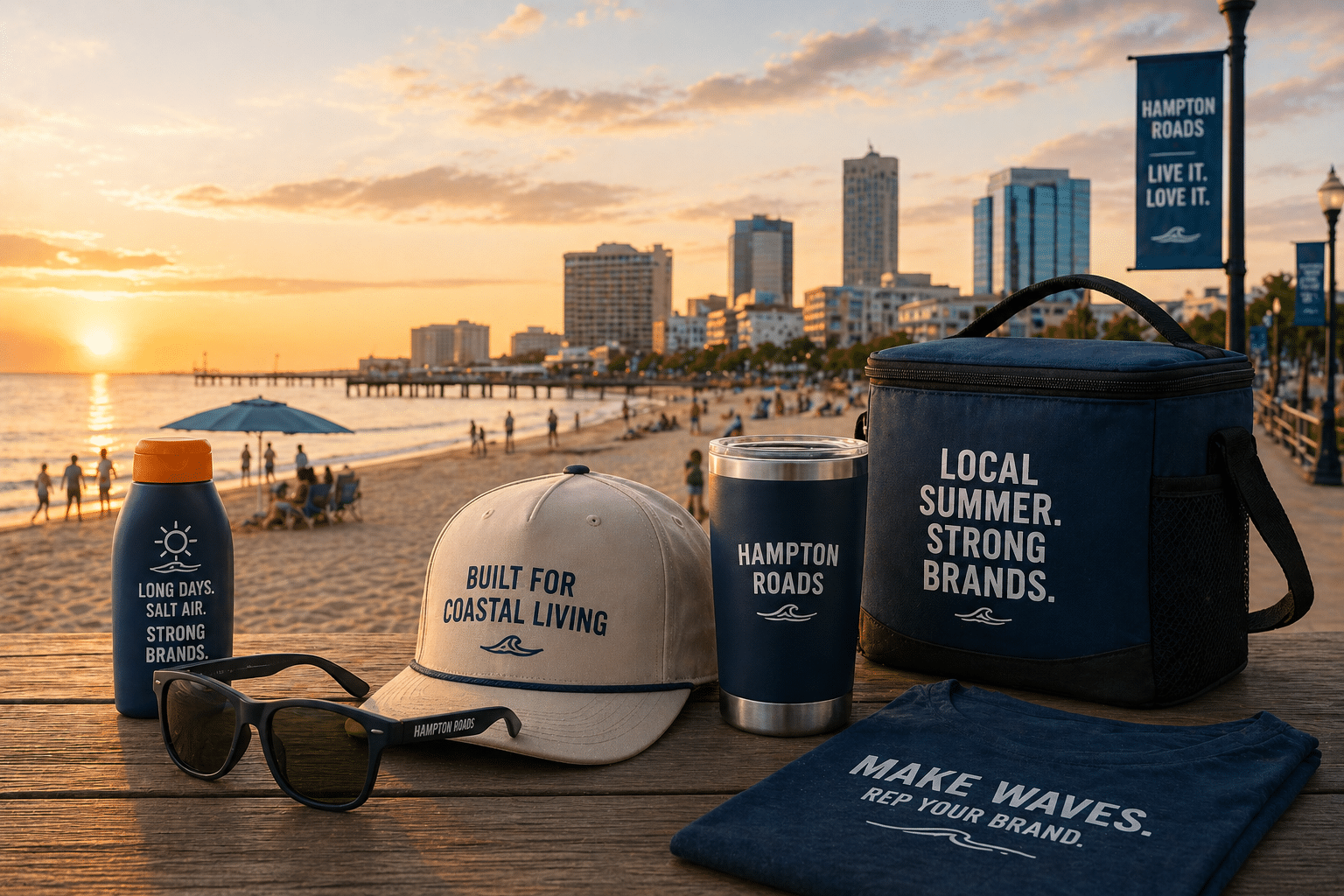
A quality insulated tumbler or stadium cup, something people are actively wishing they had while they’re standing in the sun at a waterfront festival. A useful tote bag made of something that holds up , not a flimsy drawstring bag but a gusseted canvas or recycled material bag that can carry purchases from the vendor tents. A flat-brimmed or structured hat in a colorway that doesn’t immediately read as corporate. A cooling towel, reef-safe sunscreen, or portable fan , items that solve an immediate problem the attendee is already experiencing.
What the occasion in 2026 specifically calls for:
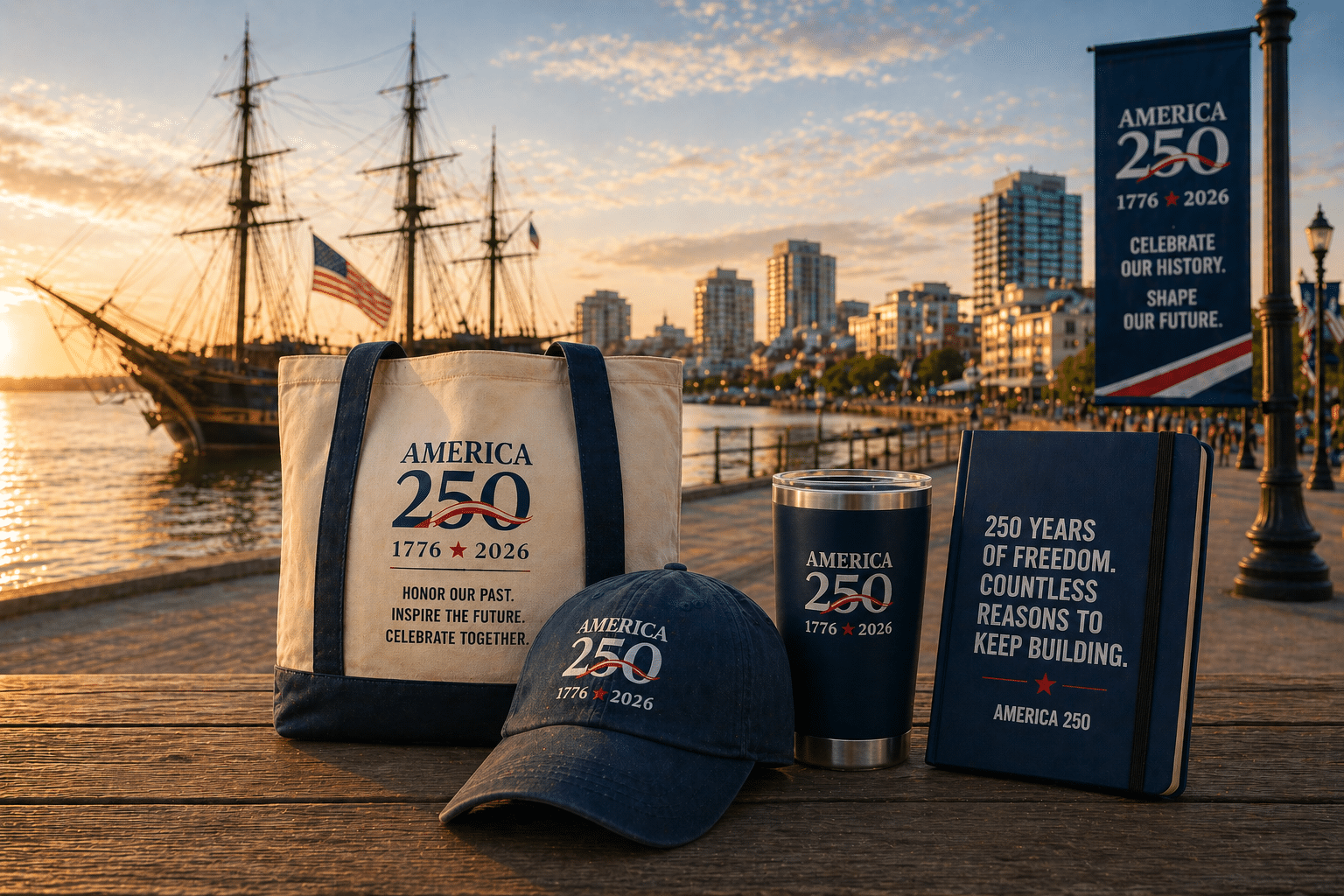
The summer of Sail250 has a specific visual and emotional register. Tall ships, maritime heritage, waterfront celebration, historical weight paired with civic pride. Sponsors who connect their giveaways to that register , without being generic about it , will have items that feel part of the moment rather than adjacent to it. A quality insulated tumbler with a nautical or maritime design element, made in Virginia, for a Virginia event celebrating Virginia’s role in American history, is not the same as a red-white-and-blue koozie. One is a keepsake. The other is a tote bag filler.
Your Hampton Roads summer sponsor playbook
This is the sequence that separates sponsors who execute well from ones who scramble.
Step one: Lock the calendar, assign the events.
Not every event on the Hampton Roads summer calendar is the right one for every brand. Sand Soccer’s 11,000 athletes skew young, active, and competitive, right for some brands, wrong for others. Harborfest draws a broad multi-generational waterfront crowd. Neptune Festival in September is art-oriented with a strong local affront. Map your target audience against the event demographics before committing sponsorship dollars. Doing two events well is better than doing five events halfway.
Step two: Define the objective before the product.
Come back to the question from earlier: is this event for awareness, leads, community association, or retention? Each leads to a different product strategy. An awareness event needs visibility and volume. A retention event needs quality and intention. Conflating them produces average results at both.
Step three: Design for the environment, not the catalog.
Every product decision, whether signage materials, giveaway items, or packaging, should run through the outdoor event filter. Will this hold up in four hours of direct Virginia Beach sun? Will this stay in someone’s hand when the Parade of Sail wind picks up? Would someone carry this from the waterfront to their car? If the answer to any of those is uncertain, reconsider the product.
Step four: Plan for the June convergence specifically.
The Sail250/Harborfest/Juneteenth weekend is the anchor event of the summer. Sponsors appearing on the Norfolk waterfront that weekend are competing with more well-resourced organizations , Sentara, TowneBank, BAE Systems, and other official Sail250 sponsors , for attendee attention. Baseline will not register. A well-executed booth with professional signage, a quality giveaway that connects to the maritime and patriotic moment, and a defined activation strategy will stand out.
Step five: Build in production lead time.
This is the most consistently underestimated variable in event planning. A custom canopy tent panel needs design approval, print production, and shipping time. A quality apparel item needs sizing decisions, decoration, and fulfillment. A Sail250-themed commemorative tumbler needs artwork that passes brand standards review. For events starting June 5 with Sand Soccer, planning conversations should be happening in April. For the June 19 waterfront weekend, May is the latest responsible start date.
Step six: Have a reorder plan.
Events run long. Giveaway supply runs out. A banner gets damaged. The reorder question is not whether it will happen, it’s whether your production partner can execute on short notice. A Virginia Beach production facility running in-house decoration and fulfillment can turn around a replacement order in a timeline that a national vendor shipping from the Midwest cannot. That proximity matters on the Friday before a Saturday event.
The question worth asking before you book the booth
There is a question that separates sponsors who get ROI from their Hampton Roads summer investment from ones who write it off as brand awareness they can’t measure:
What does someone who interacts with your booth do differently because of it?
If the answer is nothing, if they took a pen, walked away, and can’t remember the brand name, then the sponsorship generated logo impressions at the cost of booth fees, production costs, and staff time. That’s not nothing, but it’s close.
If the answer is something concrete, if they used the tumbler all summer, scanned your QR code, asked a real question at the booth, or felt for 30 seconds like a local brand actually wanted to be there, then the investment is working.
Summer 2026 in Hampton Roads is not a normal summer. The crowds will be larger, the events will be better attended, the photos will circulate more widely, and the impression your brand makes on the waterfront will travel further than usual. The question is whether what you show up with is equal to the moment.
A flapping banner and a box of koozies is not equal to Sail250. Something worth the summer is.
MSP Design Group has in-house production capabilities in Virginia Beach for event signage, branded apparel, and promotional merchandise , which means faster turnaround, local accountability, and a partner who knows what holds up in Hampton Roads heat and wind. If you’re planning your 2026 summer event sponsorship and want to build a program that actually works for the environment you’ll be in, we’d welcome the conversation. Talk to our team.


Increase Your Results with Branded Merchandise Solutions
Elevate Your Brand with Custom Merchandise
Our personalized service, global sourcing, local production, and in-house creative team make finding the perfect promotional products a breeze.
Discover the Perfect Promotional Products for Your Brand! Click Here to Get Started.
Design Custom Apparel that People Love to Wear
Our 100,000 sq ft state-of-the-art facility handles a wide range of apparel and decoration methods. Let’s create something on-trend and truly unique for your brand.
Create Trendy, Custom Apparel for Your Brand!
Make A Lasting Impression with Impactful Visual Communications
From signage and wayfinding to environmental graphics, our expert team can create custom solutions that elevate your brand and guide your audience.
Elevate Your Brand with Custom Visual Communications! Click Here to Learn More.
 Online Solutions to Elevate Your Brand
 Online Solutions to Elevate Your Brand
Our ecommerce solutions are perfect for gifting, rewards and recognition programs, team gear, fundraising, or selling your products directly to customers. Our advanced platforms offer seamless shopping experiences, fun gifting options, and secure transactions.
Boost Your Brand with Our Ecommerce Solutions! Click Here to Explore.
We Do the Heavy Lifting So You Don’t Have To
 We Do the Heavy Lifting So You Don’t Have To
MSP Design Group provides an in-house, NetSuite enabled kitting, warehouse and fulfillment facility. We provide end-to-end solutions tailored to your unique needs. With complete control of our processes, your program is in excellent hands.
Streamline Your Operations with Our End-to-End Solutions!
Our In-House Creative Team Has You Covered
 Our In-House Creative Team Has You Covered
Looking to create your own unique apparel designs? Envision a unique product that doesn’t exist yet? Want to create a new experience? MSP Design Group’s team of in-house creatives, designers, merchandisers and program experts are ready to help bring your vision to life.
Bring Your Vision to Life with Our In-House Creative Team! Click Here to Learn More.