
Your New Hire’s First Box Matters More Than Their First Day
Read Time:
8.7 minutes
Categories:
Date Posted:
June 15, 2026
And most fast-growing companies are getting it completely wrong.
I want to share a number with you.
69%.
That’s the percentage of employees who are more likely to stay with a company for three years if they experience great onboarding.
Read that again. Nearly seven out of ten people decide whether they’re staying — before they’ve done a single day of real work.
And yet, when I talk to People Ops leaders at fast-growing companies, I keep hearing the same story.
“We sent a Slack invite and a laptop.”
“We mailed them a generic company t-shirt. It was the wrong size.”
“We told them the swag store would be live soon. That was six months ago.”
Here’s the thing: you are competing for the best engineers, researchers, and operators on the planet. These people have options. Multiple offers. They are evaluating you as hard as you are evaluating them — and they do not stop evaluating when they sign the offer letter.
The box that arrives at their door before day one? That is still the interview.
The Problem Nobody Talks About: The Week Before Day One
Think about what happens between offer accepted and first day.
Your new hire is excited. They told their family. They updated their LinkedIn. They’re reading your website, watching your YouTube channel, Googling your CEO.
And then they wait.
For most companies, that gap is filled with paperwork, IT setup instructions, and silence. Maybe a calendar invite for a Monday morning Zoom.
That gap is a brand moment. And most companies leave it completely empty.
The companies that are winning the talent game right now — the ones that show up in “best places to work” rankings and have new hires posting about them on day one — have figured out something simple.
They fill the gap with something physical.
Why Physical Still Wins in a Digital-First World
You’d think a branded box of merchandise would feel out of place in 2026.
It doesn’t.
It feels more impactful precisely because everything else is digital.
Your new hire has signed a digital offer. Completed a digital background check. Attended a digital orientation meeting. Everything that has happened to them in the hiring process has lived on a screen.
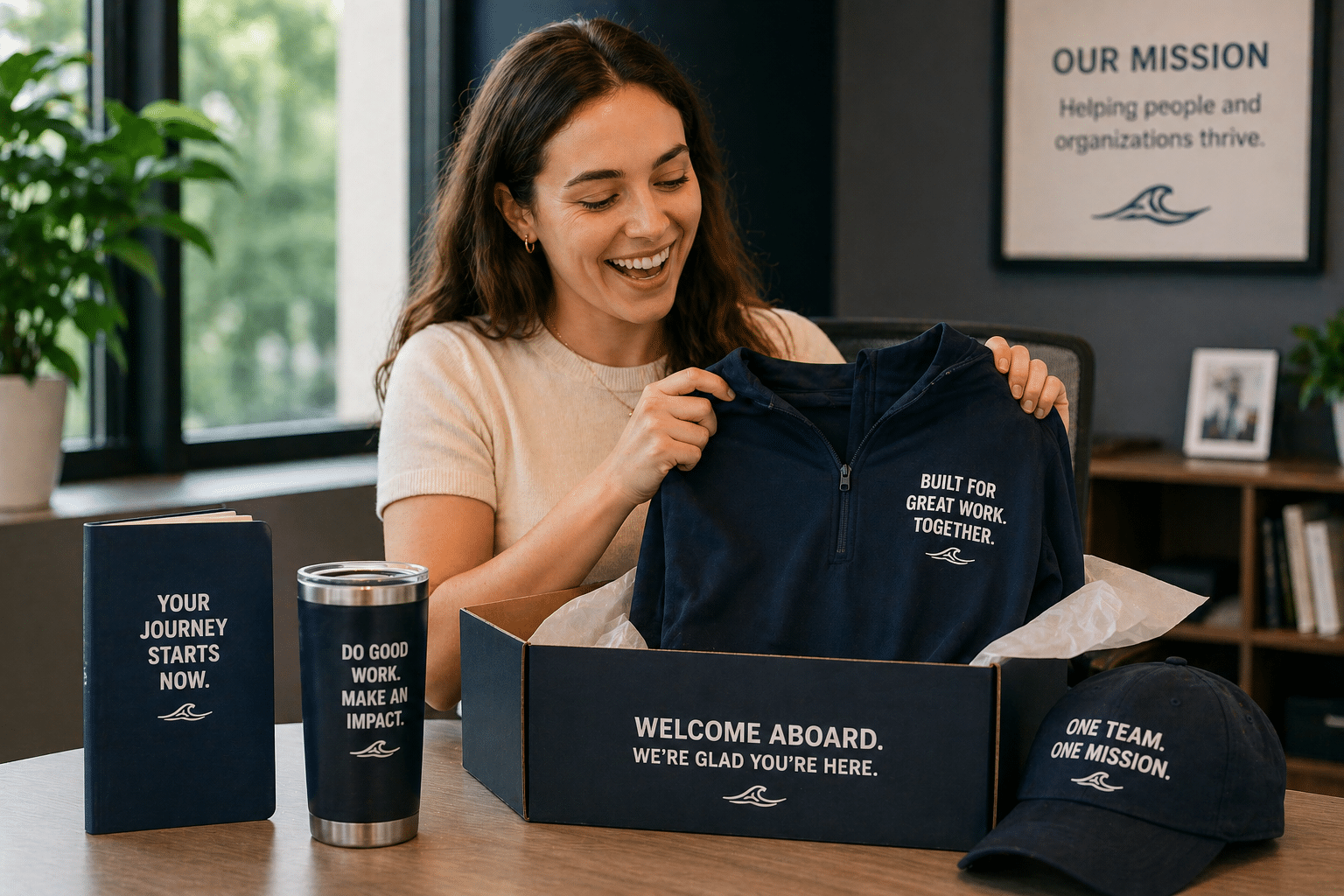
And then a box shows up at their front door.
With their name on it.
With the company’s logo on it.
Containing things that are clearly not from a generic gifting service.
That moment — opening the box — creates an emotional response that no Slack message or welcome email can replicate. Neuroscience backs this up. Physical objects activate more of the brain’s sensory processing than digital content. They’re more memorable. They create stronger emotional associations.
And here’s the marketing upside that nobody puts in their ROI calculation:
New hires post about good onboarding kits on LinkedIn. Without being asked.
I’ve seen it happen at company after company. A well-assembled, on-brand kit shows up at someone’s home. They take a photo. They post it. They tag the company. The company shares it.
That’s free employer brand content — created by the employee you just spent $15,000 to recruit — before they’ve walked through your door.
What’s Actually in a Great Onboarding Kit
Let me be specific, because “branded merchandise” means something different to every People Ops leader.
A great onboarding kit for a fast-growing company is not:
- A pile of cheap swag from a generic promo site
- A company t-shirt in the wrong size with a logo that fades after three washes
- A coffee mug they already have five of
- A tote bag that will live in their closet
A great kit is a curated, intentional collection of items that a person will actually use — and that will keep your brand in their visual field every day.
Here’s what that looks like at different program scales:
Under $30 Per Kit — Built for Scale
This tier is not about luxury. It’s about presence.
For intern cohorts or large hiring classes, you don’t need to spend $150 per head. You need to send a consistent, well-branded message to a lot of people at a manageable cost.
What goes in it:
- Branded t-shirt (retail fit, quality cotton-poly blend)
- Custom sticker sheet (4–6 designs — these end up on laptops)
- Branded notebook and pen
- Custom packaging with a welcome card
The goal: Every single new hire feels like someone prepared for them. That’s it. At this scale, consistency beats luxury.
$30–$75 Per Kit — The Most Common Starting Point
This is where most fast-growing companies begin their first real program. And for good reason.
The items at this tier are genuinely useful. They’re the things a person reaches for every day — an insulated tumbler, a quality tote, a hardcover notebook. Your brand goes everywhere they go.
What goes in it:
- Insulated tumbler, 20–30 oz (the anchor item — it travels everywhere)
- Branded canvas tote
- Hardcover notebook with ribbon bookmark
- Curated desk snacks
- Custom packaging with a welcome card and a handwritten note prompt
The snacks are not filler. They’re the warmest touch in the box. New hires share them, post about them, mention them in first-week Slack intros.
$75–$150 Per Kit — When the Hire Is Competitive
Remote hires. Senior individual contributors. People who had three offers on the table.
At this tier, the kit is doing real work.
What goes in it:
- Name-brand apparel (Patagonia, Nike, North Face — your brand on their back in video calls)
- Premium insulated drinkware (Yeti Rambler, Stanley Quencher)
- Tech accessory for home office (wireless charger, portable power bank)
- Wellness item (yoga mat, premium hand cream set, plant kit)
- Premium rigid box with a printed welcome booklet — not just a card
When a senior hire opens this box before day one, they’re not receiving swag. They’re receiving a message: We chose you. We were ready for you.
That message is worth more than the cost of the kit.
$150–$250+ Per Kit — Executive Level
For VP, Director, and C-suite hires, the kit has to match the hire.
Luxury items, minimal branding footprint, maximum personalization. Think Tumi backpack. Patagonia Better Sweater. Laser-engraved Yeti. Leather-bound notebook with their initials debossed.
And — this is the most important element in the entire kit — a handwritten note from the CEO.
Not a printed card. A handwritten note.
That note costs nothing to produce and is the single item the executive will remember six months later.
The Direct-to-Hire Logistics Question
Here’s where most onboarding kit programs fall apart.
Getting branded merchandise from a distributor to 50 new hires in 12 different states, before their start dates, with the right sizes, to the right addresses, without a dedicated logistics team — is genuinely hard.
Most companies either:
- Ship to the office and hope new hires pick it up (terrible for remote employees)
- Ask the HR coordinator to manage it manually (unsustainable)
- Abandon the program after the first chaotic quarter
The companies that run these programs at scale have solved the logistics problem before they solve the merchandise problem. Here’s what that looks like:
Pilot Programs (10–25 kits): Typically handled order by order. Higher per-unit cost. Lead time of 3–4 weeks from artwork approval. Right for proof of concept.
Mid-Scale Quarterly Programs (50–100 kits): Batch production aligned to hiring cohorts. Pre-staged inventory becomes possible. Lead time drops to 2–3 weeks. One PO per quarter.
Enterprise Programs (100+ kits): Pre-staged inventory at a fulfillment facility. Kits assembled and shipped within 24–72 hours of hire confirmation — to any address in the US. HRIS integration available. A hire signs their offer on Monday. Their kit arrives before their start date. Regardless of where they live.
The Three Mistakes People Ops Leaders Make
I’ve seen a lot of onboarding kit programs. Here are the three mistakes that kill them.
Mistake 1: Waiting until day one.
The kit should arrive before day one. That’s the whole point. You’re filling the gap between offer accepted and first day — the emotional window when new hires are most engaged and most anxious. A kit that arrives on Monday morning gets opened at the desk. A kit that arrives on Friday gets opened at home, photographed, and posted.
Mistake 2: Guessing on apparel sizes.
Nothing deflates a great kit faster than a t-shirt that doesn’t fit. Collect sizing information at the offer stage — build it into your offer acceptance workflow, not your onboarding checklist. By the time you’re ordering the kit, you should already have the size.
Mistake 3: Treating the packaging as an afterthought.
The unboxing experience is the brand moment. A great kit in a generic brown mailer is a missed opportunity. A good kit in a custom rigid box with branded tissue and a thoughtful welcome card outperforms it every time. The packaging is not a cost to minimize. It’s half the product.
What This Actually Costs — and What It Gets You
Let me give you the math.
You spent roughly $15,000 to recruit this person. Job boards, recruiter fees, interview time, background check.
A Tier 2 onboarding kit runs $35–$75 per person. Shipping adds $12–$20 depending on location.
So you’re spending $50–$95 — against $15,000 — to protect a relationship that took months to build.
That’s not a cost. That’s insurance.
Now add the upside:
- Retention lift: Employees who experience structured onboarding are 58% more productive in their first 90 days (Glassdoor, 2024).
- LinkedIn content: A photographed unboxing post from a new hire reaches their entire professional network — often 500–2,000 connections in your exact talent market.
- Employer brand: Every kit that ships is a proof point you can use in recruiting conversations.
The ROI on a well-executed onboarding kit program is not a nice-to-have. It’s measurable.
How to Start
You don’t need to build the perfect program on day one.
Start with a pilot. Pick your next hiring cohort — 10 to 25 people. Build a Tier 2 kit. Ship it before their start dates. Photograph the results. Ask new hires what they thought in their week-two check-in.
Then scale from there.
The fast-growing companies that are winning the talent war in 2026 are not winning because they have the highest salaries. They’re winning because they’ve figured out that culture is communicated in moments — and the moment before day one is one of the most powerful moments they have.
Fill it with something worth remembering.
MSP Design Group works with fast-growing companies to design, produce, and fulfill branded onboarding kit programs — from pilot runs to enterprise direct-to-hire programs at scale. If you want to see what a program could look like for your team, Talk to a Brand Consultant.
Related reading: 5 Curated Welcome Kits to Help You Boost Employee Retention
Related reading:

Increase Your Results with Branded Merchandise Solutions
Elevate Your Brand with Custom Merchandise
Our personalized service, global sourcing, local production, and in-house creative team make finding the perfect promotional products a breeze.
Discover the Perfect Promotional Products for Your Brand! Click Here to Get Started.
Design Custom Apparel that People Love to Wear
Our 100,000 sq ft state-of-the-art facility handles a wide range of apparel and decoration methods. Let’s create something on-trend and truly unique for your brand.
Create Trendy, Custom Apparel for Your Brand!
Make A Lasting Impression with Impactful Visual Communications
From signage and wayfinding to environmental graphics, our expert team can create custom solutions that elevate your brand and guide your audience.
Elevate Your Brand with Custom Visual Communications! Click Here to Learn More.
 Online Solutions to Elevate Your Brand
 Online Solutions to Elevate Your Brand
Our ecommerce solutions are perfect for gifting, rewards and recognition programs, team gear, fundraising, or selling your products directly to customers. Our advanced platforms offer seamless shopping experiences, fun gifting options, and secure transactions.
Boost Your Brand with Our Ecommerce Solutions! Click Here to Explore.
We Do the Heavy Lifting So You Don’t Have To
 We Do the Heavy Lifting So You Don’t Have To
MSP Design Group provides an in-house, NetSuite enabled kitting, warehouse and fulfillment facility. We provide end-to-end solutions tailored to your unique needs. With complete control of our processes, your program is in excellent hands.
Streamline Your Operations with Our End-to-End Solutions!
Our In-House Creative Team Has You Covered
 Our In-House Creative Team Has You Covered
Looking to create your own unique apparel designs? Envision a unique product that doesn’t exist yet? Want to create a new experience? MSP Design Group’s team of in-house creatives, designers, merchandisers and program experts are ready to help bring your vision to life.
Bring Your Vision to Life with Our In-House Creative Team! Click Here to Learn More.