
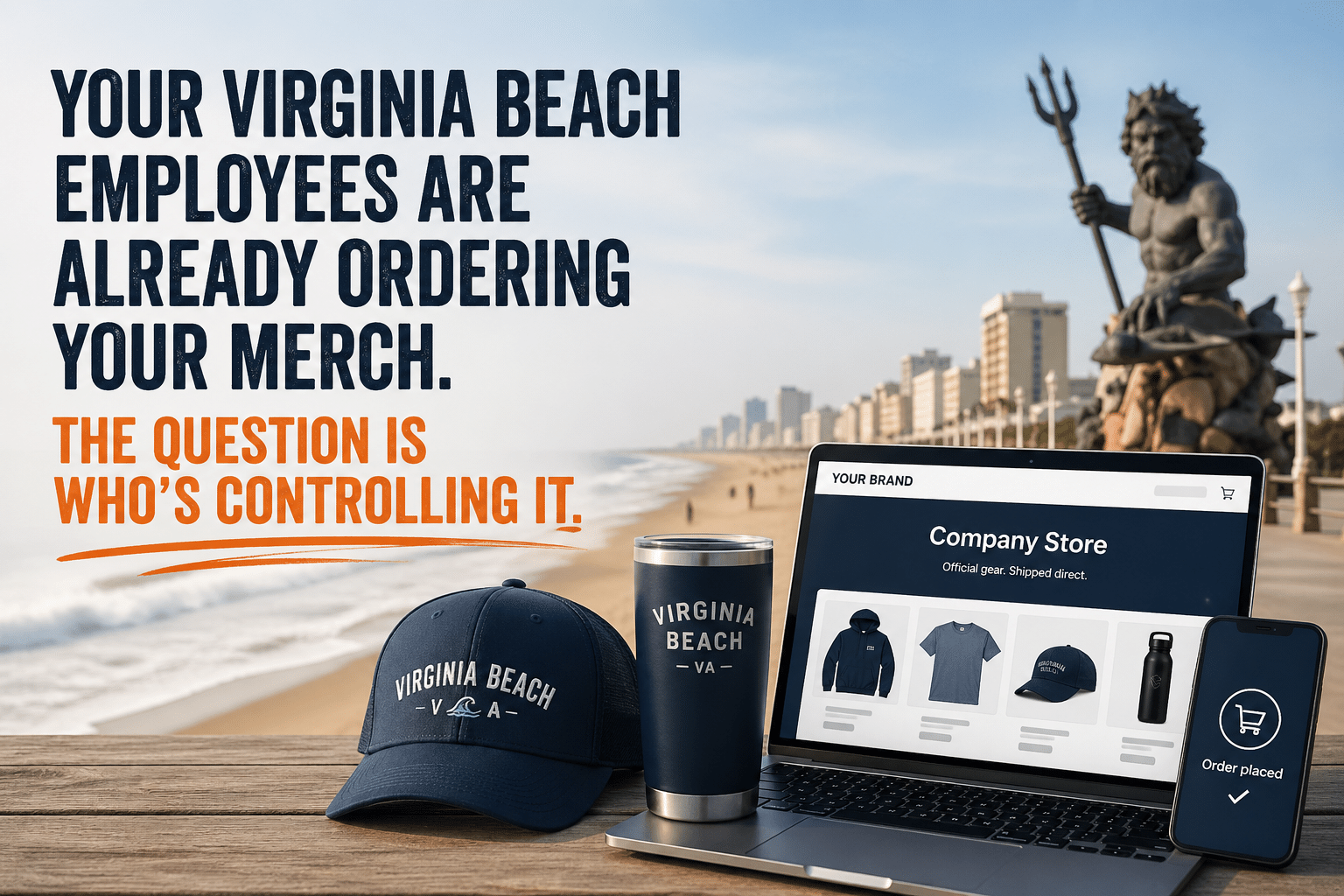
Your Virginia Beach Employees Are Already Ordering Your Merch. The Question Is Who’s Controlling It.
Read Time:
11 minutes
Categories:
Tags:
Date Posted:
February 1, 2026
Most company stores fail before they launch , not because the platform is wrong, but because nobody asked the right question first.
Here’s a scenario that plays out more often than HR leaders want to admit. Marketing orders branded polos for a client event. The operations manager orders different branded polos for the new hire class starting Monday. Sales orders branded polos for the trade show in Charlotte next month. Three departments. Three vendors. Three slightly different shades of the same blue. Three different logo files, because nobody could find the approved one. Three separate shipping invoices sitting in three separate inboxes.
Nobody did anything wrong. Everyone was just trying to get their job done. But the result is a company that looks like it can’t get its own identity straight, and an HR team that spent two hours on Tuesday tracking down order confirmations instead of doing the work they were hired to do.
This is the problem a company store solves. And it’s why a growing number of mid-size Hampton Roads employers are building them.
Key takeaways
- The real cost of decentralized merchandise ordering isn’t the price per unit , it’s the administrative time, brand inconsistency, and missed volume pricing that compound quietly over months.
- A company store is not a merch shop. It’s an operational system that controls what gets ordered, who can order it, and what it looks like when it arrives.
- Most stores that underperform were built around the wrong product selection , items that look good in a catalog but don’t fit how employees actually dress and work.
- Local fulfillment matters more than most buyers realize. When an order ships from across the country and arrives wrong, you’re waiting a week to fix it. When your fulfillment partner is in Virginia Beach, you’re not.
- The five questions in this post’s playbook section will tell you whether your organization is ready to build a store , and what it needs to do well.
Table of contents
- The official story: company stores are for big companies
- The reality: mid-size Hampton Roads employers are the ones who need them most
- Why decentralized ordering is more expensive than you think
- The five things that separate a store people use from one that collects digital dust
- Your company store playbook
- The question worth asking before you build
The official story: company stores are for big companies
The assumption most HR and operations leaders carry is that company stores are an enterprise solution. You picture a Fortune 500 brand with a dedicated team managing SKUs, a branded portal that took six months to build, and an IT integration nobody fully understands. That’s the image. And for most mid-size companies in Virginia Beach, Norfolk, or Chesapeake, it’s enough to make the idea feel out of reach before anyone even starts a conversation.
The other version of the official story is simpler: you just pick a vendor, upload your logo, and you’re done. Plug-and-play. Thirty minutes of setup and you have a store. Which technically is true. You can have a store in thirty minutes. What you can’t have in thirty minutes is a store that actually solves the problem it was supposed to solve.
Both versions of the story , too complicated, or too easy , end up steering companies away from doing this right.
The reality: mid-size Hampton Roads employers are the ones who need them most
The companies that benefit most from a well-run company store are not the ones with a dedicated procurement team and a brand manager who reviews every order. Those organizations already have infrastructure for this. The companies that benefit most are the ones with 75 to 500 employees, multiple departments with different needs, hybrid or distributed teams, and an HR function that is already stretched doing three jobs at once.
That description fits a significant portion of the Hampton Roads employer base. Defense contractors with offices across multiple Virginia Beach and Norfolk locations. Healthcare practices with administrative staff, clinical staff, and a front-desk team that all need different things but should all look like the same organization. Regional construction and engineering firms where field crews, project managers, and business development staff each have their own merch requirements. Professional services firms that want to show up consistently at events but can never agree on which polo is “the polo.”
For these organizations, the chaos of decentralized ordering isn’t a minor inconvenience. It’s a real drag on brand consistency, a hidden cost center, and a time sink that HR and operations absorb without ever putting a number on it.
A company store doesn’t fix all of that automatically. But it creates the conditions where it can get fixed.
Why decentralized ordering is more expensive than you think
The number on the invoice is not the cost of your branded merchandise program. The actual cost includes everything wrapped around that invoice that nobody tracked.
Think about what happens when your team orders without a centralized system. Different departments hit different vendors, which means nobody is hitting the volume threshold for better pricing. One department is paying $28 for a polo that another department is paying $22 for from a different supplier, because someone found a deal, or used whoever they used last time, or Googled “branded polo Virginia Beach” and picked the first result. Meanwhile, the logo files are different, the Pantone color is slightly off on one of them, and you won’t notice until everything shows up and the CEO is standing next to an employee at an event wearing two versions of the same shirt.
Then there’s the inventory problem. Without a store, departments over-order to avoid running out. Those extra 40 hoodies from the Q3 hiring push are sitting in a box in the break room. They will still be there in March. The administrative overhead is real too, every independent order means someone spent time researching vendors, getting quotes, chasing shipments, and handling returns. That time is not free even when nobody bills for it.
A centralized store eliminates most of this. One approved product catalog. One set of logo files with correct specs. One vendor relationship with volume pricing built in. One system that tracks what was ordered, when, and by whom. The upfront investment in building the store pays back in the first two or three ordering cycles for most mid-size organizations.
The five things that separate a store people use from one that collects digital dust
This is where most well-intentioned company store projects quietly fail. The platform works fine. The logo is correct. The store goes live. And then three months later, the usage numbers are terrible and nobody knows why.
Here’s what the underperforming stores almost always have in common.
-
The product selection was built for the catalog, not the workforce.
Somebody sat down with a product guide and picked items that looked good on a page. Heavyweight fleece pullovers for a team that works outside in Virginia Beach in August. Structured dress polos for a maintenance crew. Premium leather portfolios for employees who work in a warehouse. The items are not wrong, they’re just wrong for these people in these jobs. Before any product goes into a store, the question is simple: will this person actually wear or use this in their real working life? If the honest answer is no, it does not belong in the store.
-
There are too many options.
A store with 60 products is not better than a store with 15 products. It is harder to navigate, harder to manage inventory for, and harder to keep on-brand. Employees faced with too many choices often make no choice at all, or pick whatever is cheapest rather than whatever is best. The stores that get used are the ones where someone made curatorial decisions up front and kept the catalog focused.
-
Nobody told employees it existed.
A store launch is a communication event, not just a technical go-live. If the announcement is one paragraph in a company-wide email on a Tuesday afternoon, the adoption rate will reflect that. The stores that get traction are the ones where leadership talks about them, new hire onboarding includes them, and there’s a recurring reason for employees to come back, a seasonal refresh, a recognition program tied to store credit, a new hire welcome kit that ships from the store automatically.
-
The fulfillment experience is inconsistent.
An employee orders a jacket. It arrives two weeks later in the wrong size. The return process requires three emails and a phone call. That employee orders from Amazon next time, with their own logo-adjacent item, which then shows up at the client meeting looking nothing like the company’s actual brand. Fulfillment quality is not a back-office detail. It’s what makes employees trust the store enough to use it again.
-
The store was built as a one-time project, not an ongoing program.
Products go out of date. Sizing runs change. New departments come on. Seasonal needs shift. A company store that launched well and then sat untouched for 18 months is not doing its job anymore. The organizations that get the most value from their stores treat them as a living program, with quarterly reviews, a clear owner internally, and a fulfillment partner who flags when inventory or product selection needs attention.
Your company store playbook
If you’re a Hampton Roads HR or operations leader thinking about building a company store , or rebuilding one that isn’t working , here’s where to start.
Before you build, answer these five questions:
- Who is the internal owner? Not who approved the project, but who owns it day-to-day: who updates the product catalog, communicates with employees about it, and reviews the quarterly usage report. If there is no clear answer, the store will drift.
- What problem are you actually solving? Brand inconsistency across departments? Administrative time spent managing orders? New hire onboarding experience? Recognition program logistics? The store’s design should follow the answer. A store built to fix brand consistency looks different from a store built to power a recognition program.
- What does your workforce actually do all day? A hybrid professional team in Virginia Beach has different needs than a field crew at a construction site in Norfolk. The product catalog should be built around how your employees actually dress, work, and move, not around what looks good in a pitch deck.
- What is your fulfillment expectation? How quickly do you need orders to arrive? What happens when something arrives wrong? Who handles returns? These questions matter more than platform features. A store is only as good as the experience it delivers when an employee clicks “order.”
- Do you have a launch plan? A store that goes live quietly stays quiet. Plan the announcement, build it into new hire onboarding, and give employees a reason to visit, whether that’s a launch promotion, a store credit tied to a recognition milestone, or a seasonal product refresh.
What to look for in a fulfillment partner:
The platform that runs the store and the partner who fulfills the orders are not the same decision, and the second one matters more than most buyers realize when they’re comparing options. Questions worth asking:
- Do you have in-house production, or are you outsourcing decoration to a third party? (In-house means faster turnaround and tighter quality control.)
- Where does inventory live, and how quickly can an order ship? For Hampton Roads companies, a local fulfillment center is a real operational advantage , not a marketing point.
- What does the error correction process look like? Wrong items, wrong sizes, and logo inconsistencies happen. How a partner handles them tells you more than their uptime statistics.
- Can the store scale with us? New locations, new departments, new product categories , does the platform and the relationship support that without starting over?
The question worth asking before you build
Here’s the honest version of what a company store is: it’s a commitment. It requires an internal owner, a thoughtful product selection, a reliable fulfillment partner, and ongoing attention. Done right, it removes a significant amount of operational drag from HR and operations, protects brand consistency across a distributed workforce, and gives employees a better experience with their own company’s identity. Done as an afterthought , picked up because “we should probably have one of these” , it becomes one more digital property that nobody maintains and everybody ignores.
The question is not whether your organization is big enough for a company store. Hampton Roads mid-size employers are exactly the right size for this. The question is whether you’re willing to treat it like the operational system it is, rather than the swag shop it’s often mistaken for.
If the answer is yes, the next conversation is about what yours should actually look like: what it’s solving, who it’s for, and what it needs to do well. That conversation is worth having before the platform decision, before the product catalog, and well before the launch date.
MSP Design Group operates a 100,000 sq ft production facility in Virginia Beach with in-house screen printing, embroidery, and fulfillment , which means the stores we build and run are backed by local production and local accountability. If you’re a Hampton Roads employer thinking through what a company store could look like for your organization, we’re happy to walk through it with you. Get in touch with our team.


Increase Your Results with Branded Merchandise Solutions
Elevate Your Brand with Custom Merchandise
Our personalized service, global sourcing, local production, and in-house creative team make finding the perfect promotional products a breeze.
Discover the Perfect Promotional Products for Your Brand! Click Here to Get Started.
Design Custom Apparel that People Love to Wear
Our 100,000 sq ft state-of-the-art facility handles a wide range of apparel and decoration methods. Let’s create something on-trend and truly unique for your brand.
Create Trendy, Custom Apparel for Your Brand!

Make A Lasting Impression with Impactful Visual Communications
From signage and wayfinding to environmental graphics, our expert team can create custom solutions that elevate your brand and guide your audience.
Elevate Your Brand with Custom Visual Communications! Click Here to Learn More.
 Online Solutions to Elevate Your Brand
 Online Solutions to Elevate Your Brand
Our ecommerce solutions are perfect for gifting, rewards and recognition programs, team gear, fundraising, or selling your products directly to customers. Our advanced platforms offer seamless shopping experiences, fun gifting options, and secure transactions.
Boost Your Brand with Our Ecommerce Solutions! Click Here to Explore.
We Do the Heavy Lifting So You Don’t Have To
 We Do the Heavy Lifting So You Don’t Have To
MSP Design Group provides an in-house, NetSuite enabled kitting, warehouse and fulfillment facility. We provide end-to-end solutions tailored to your unique needs. With complete control of our processes, your program is in excellent hands.
Streamline Your Operations with Our End-to-End Solutions!
Our In-House Creative Team Has You Covered
 Our In-House Creative Team Has You Covered
Looking to create your own unique apparel designs? Envision a unique product that doesn’t exist yet? Want to create a new experience? MSP Design Group’s team of in-house creatives, designers, merchandisers and program experts are ready to help bring your vision to life.
Bring Your Vision to Life with Our In-House Creative Team! Click Here to Learn More.